

Missing maintenance logbooks can cut an airplane’s value by up to 60%. But a digital backup helps protect it.
Your airplane’s worth is based on what you can prove about it. The airframe, the engine, the avionics, the paint, all of it is only worth top dollar if you can show a buyer how it has been cared for. And that proof lives in your maintenance logbooks. Lose them, and you’ve lost a large slice of the airplane’s value.
Here is the uncomfortable part: for most owners, that irreplaceable proof exists as a single set of paper books riding around in the airplane, sitting in a drawer in the hangar or in a safe location where they’re not easy to retrieve or access. In the worst case scenario, a natural disaster or simple misplacement means those logbooks are gone.
Up to 60% of the plane’s value lies in those logbooks
Ask appraisers and valuation services what missing logbooks do to a sale, and the estimates land across a wide range, commonly anywhere from 10% to 60% of the airplane’s value depending on how much is missing and what kind of airplane it is. The spread is wide because not all gaps are equal:
- A few missing entries might cost 5% to 15%.
- Missing engine logs can cost 20% to 40%. Without them, the engine’s time since overhaul cannot be proven, and a buyer will value it as if it were run out, no matter how strong it actually is.
- Missing airframe logs tend to hit hardest, 30% to 50% or more, because the structural and modification history goes with them.
- All logs gone frequently means half the airplane’s value or worse.
On a $200,000 airplane, even the mild end of that range is real money. The severe end is catastrophic for resale value.
And it is not only the sale price. Lenders and insurers routinely want to see complete records before they will finance or cover an aircraft, so missing logs can shrink your buyer pool to cash-only shoppers hunting for a discount.

Reconstruction is possible, but it’s not a fix
You can rebuild some history after the fact, using FAA Form 337s on file, shop records, an IA’s help and a fresh set of logs. It works, partially. It also costs money, often a few thousand dollars, and it still cannot fully prove airworthiness directive compliance or true total time. A reconstructed history helps, but it never fully erases the discount, because the uncertainty is why buyers pay less.
The better (and cheaper) option is to never find yourself in that position.
Why paper is the weak link
Paper logbooks are the legal record, they’re what buyers expect to see, and you should always keep your originals safe. The problem is that a single physical copy is just that–the only copy. Over time, ink fades, pages tear loose, coffee spills, and general wear and tear isn’t always kind to logbooks. The entire value of the record depends on those paper logbooks surviving for the life of the airplane, which can be decades.
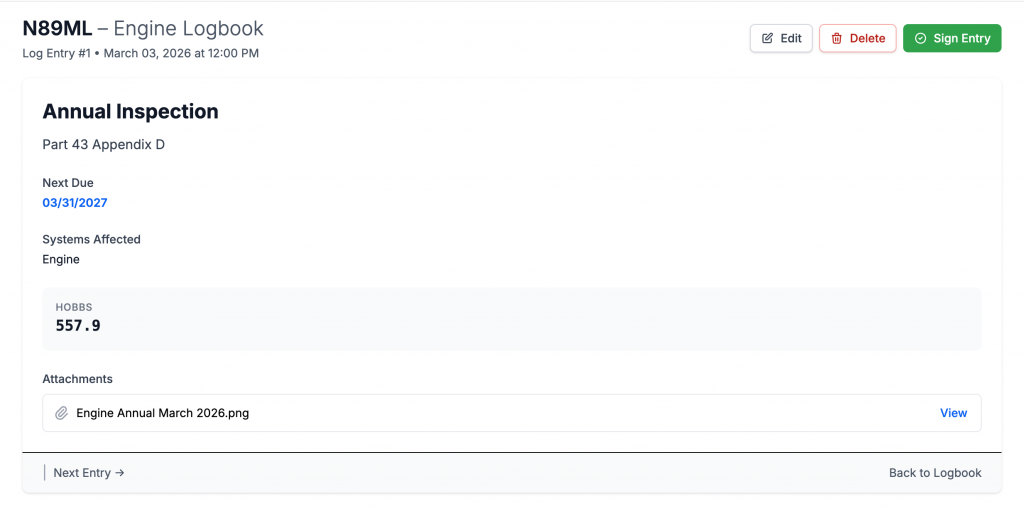
Digitizing your logbooks fixes the fragility of paper without touching the originals. A complete, organized digital record means the information survives no matter what happens to the paper. If the worst happens, you are not staring at a 40% value cut. You are printing a clean copy.
The payoff is not only for resale
A digital copy earns its keep long before you ever sell:
- Compliance is easier to prove. Airworthiness directives, inspections and overhauls are searchable instead of buried somewhere in a box.
- You actually know your times. Component and engine times stay in front of you rather than requiring a trip to the safety deposit box, or digging through storage.
- Handoffs get simple. Your mechanic, your insurer or a prospective buyer can be given a complete, organized history in minutes.
- A partnership stays on the same page. When several owners share an airplane, one shared digital record beats a paper book that only one person can hold at a time.
Keep the proof where it can’t be lost
Coflyt gives you a place to keep your maintenance records and aircraft times together in one organized, always-available spot, so your logbook history is backed up, searchable and ready to hand over the day you decide to sell. Your paper originals stay safe in a drawer. Their entire contents stay safe in the cloud.
The logbooks are worth as nearly much as the plane. So it makes sense to protect them.